Review and parallel work
The right model for the task
Gloop learns, on every project, which model does which kind of work best, from your trials and from closed work, and recommends it when you open an agent with a task.
Opus, Sonnet and Haiku aren't equally good at everything: a quick fix doesn't need the biggest model, a new feature does. Which one works best also depends on the project. Gloop learns from your work which model keeps the work most often for each kind of task, on every workspace, and tells you when you open an agent.
Kinds of work
Gloop tells five kinds of work apart:
| Kind | For example |
|---|---|
| A quick fix | A precise bug to correct. |
| Something to understand | Reading the code and explaining how something works. |
| Something to decide | Weighing different paths and proposing one. |
| A new feature | Adding something that wasn't there. |
| A refactor | Changing the shape without changing what it does: renaming across the project, splitting a big file, updating a library. |
They're the same kinds as Scout points, plus new feature and refactor.
New agent
From the arrow next to Agent: With a task → Write what it should do (or "Agent with a task" from the palette). Write the task: after a moment a small model (Haiku) proposes the kind of work, "looks like a quick fix, on this project:". If it's wrong, change it from the menu: Gloop remembers the correction and next time Haiku takes it into account.
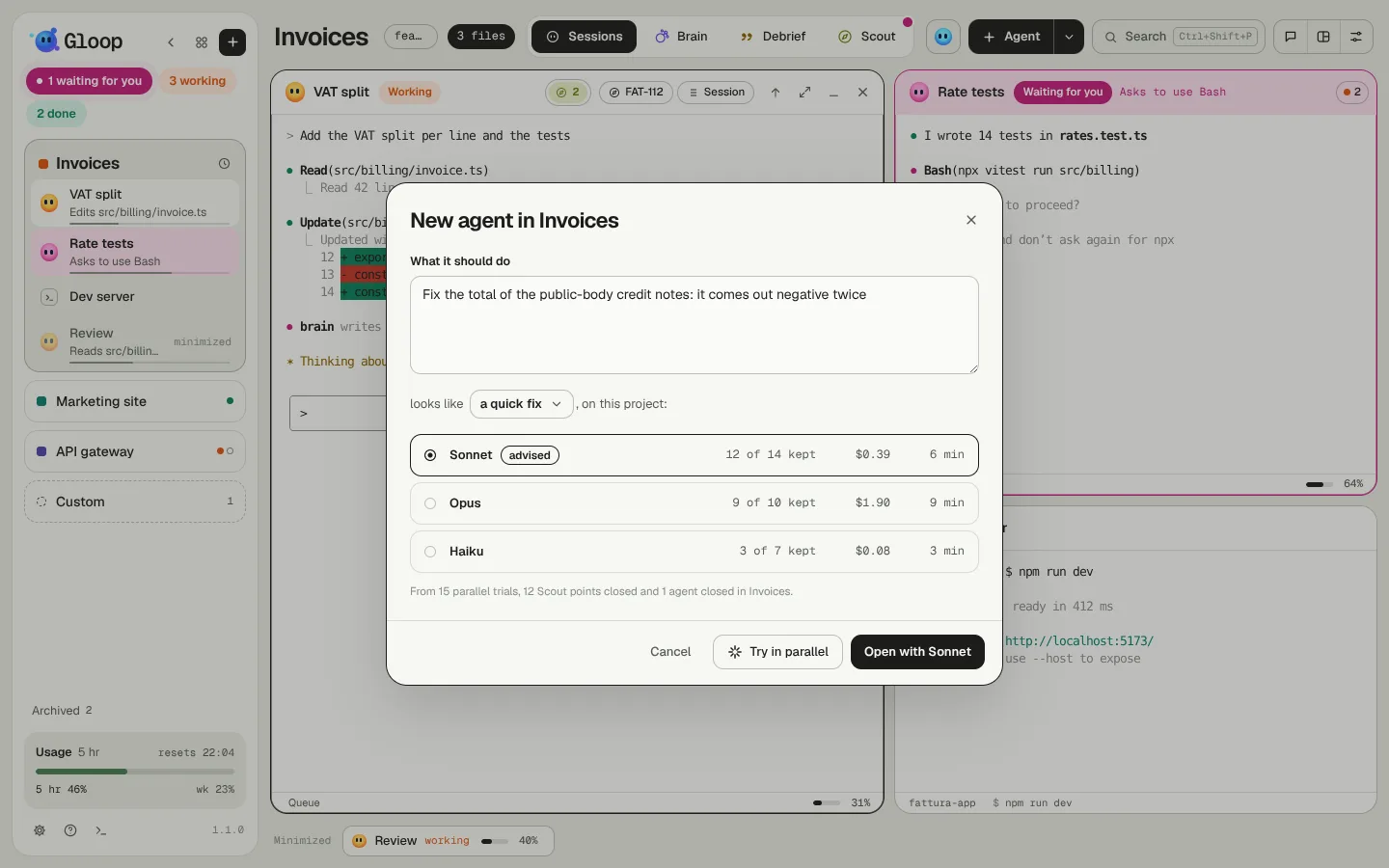
Below, one row per model, with the numbers for that kind of work in that workspace:
- kept: how many times that model's work stayed ("12 of 14");
- average cost and average time.
The recommended model has a label, and it's already chosen. Then:
- Open with… opens the agent with the chosen model and the task already written;
- Try in parallel opens the trial with two different models.
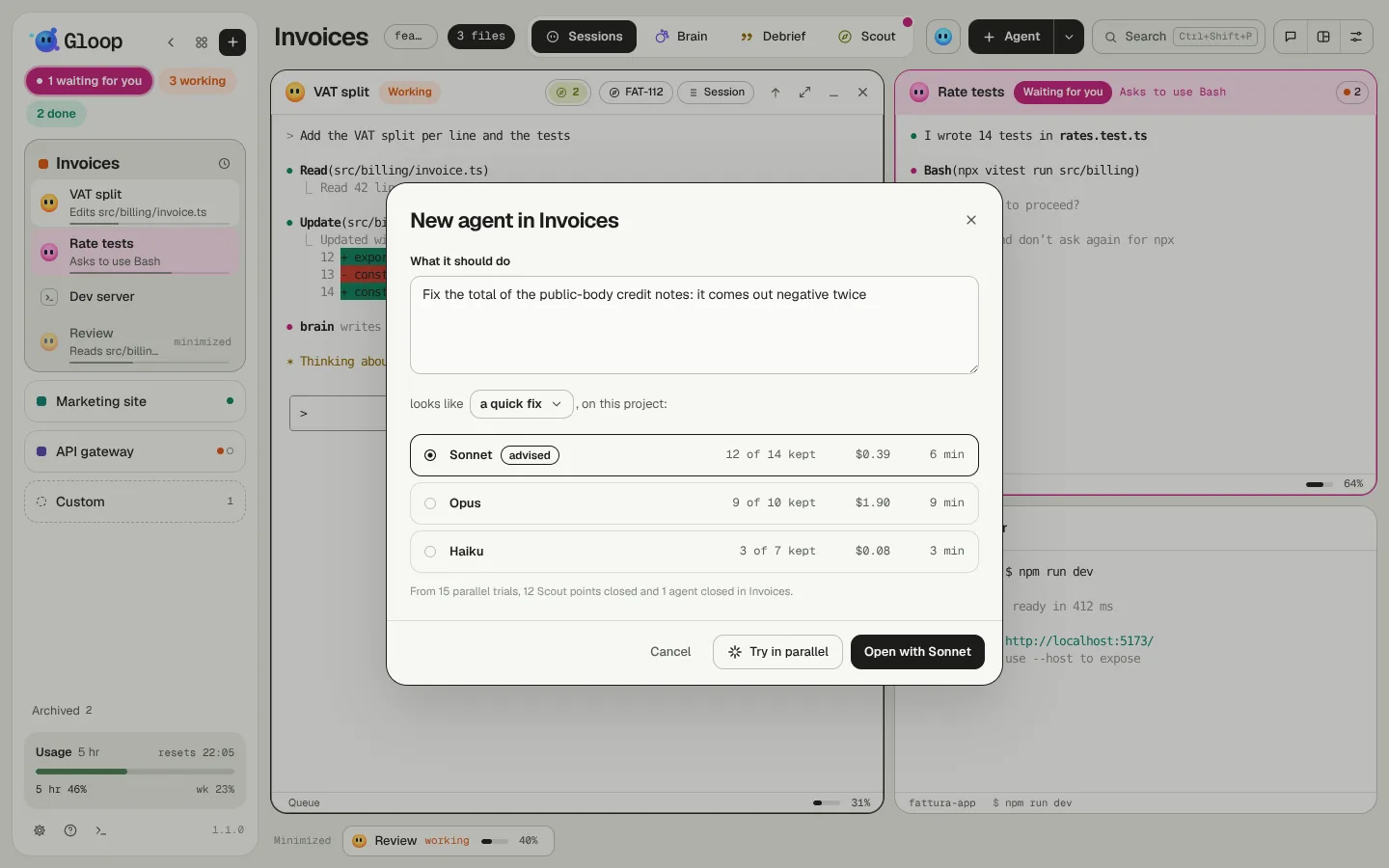
What it learns from
Each piece of work by a model on a kind is a case, with how it ended, the cost and the time (the time the model actually worked, not the time the session was open). The cases come from:
- trials in parallel with different models: when you choose which to keep, the kept variant counts as kept, the others as dropped. A trial with the same model for all teaches nothing about models;
- Scout points done by an agent: the point moved to done is kept; if it opens again or has to be redone, the case changes;
- agents opened with a task (from New agent or from the coordinator) and then closed: they give cost and time, but don't say whether the work stayed, so they don't count among the kept.
When it recommends
Gloop recommends a model only when the numbers say so clearly. It needs at least 8 cases of that model on that kind, at least one other model with 4, and it must beat them all: keeping the work much more often, or nearly as often while costing much less. Among the models that are good enough it tries the cheapest first. Until then it shows only the numbers, with no recommendation.
What Gloop has learned
In Settings → Agents → What Gloop has learned you find, for every workspace, the kind × model table with kept, average cost and time, the recommended one and where the numbers come from. Reset throws away a workspace's cases and corrections (it asks you first).
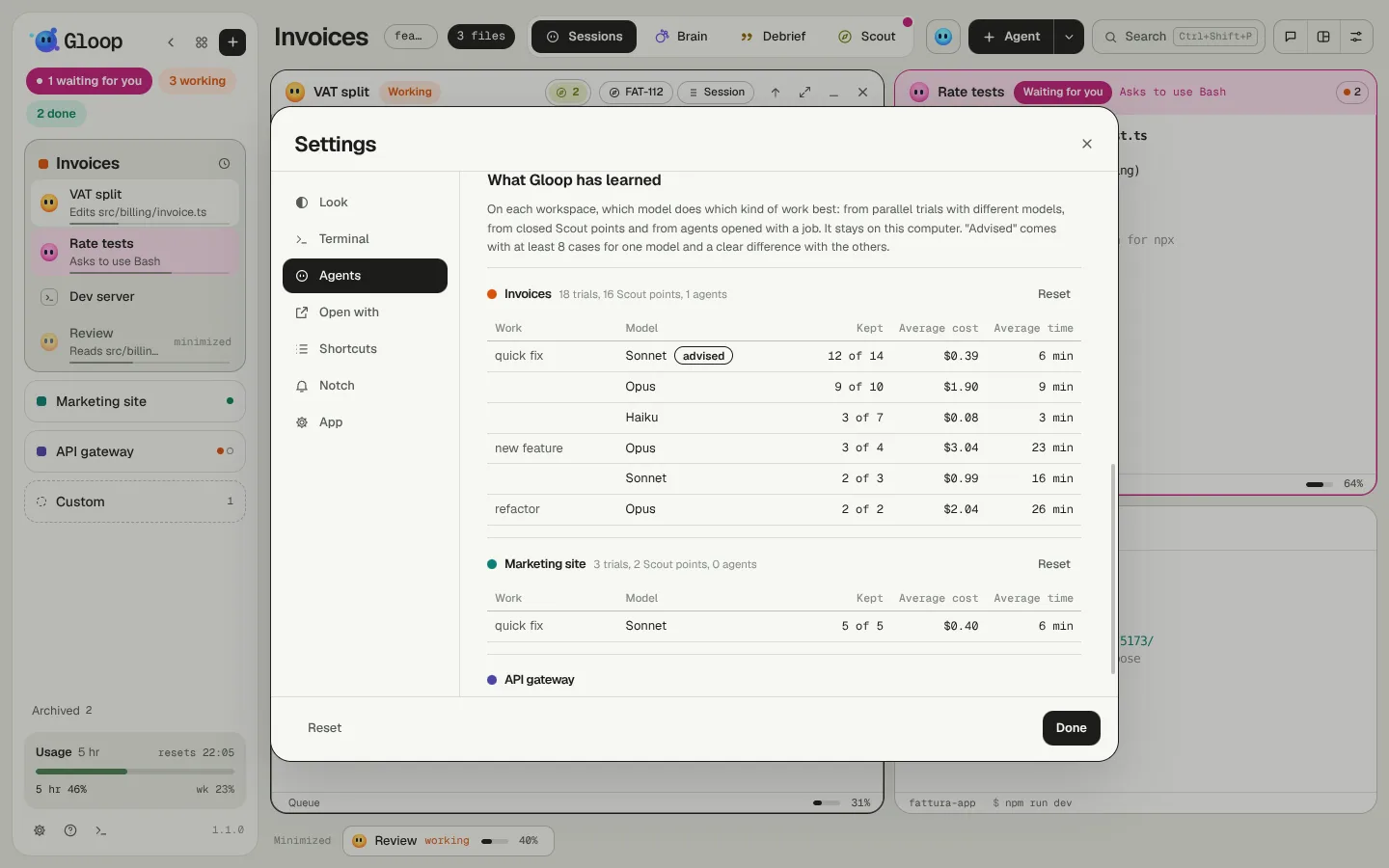
All this stays on your computer, one file per workspace. When you close a workspace, it goes too.